Indledning
This manual serves as a comprehensive guide to the "NX-OS and Cisco Nexus Switching: Next-Generation Data Center Architectures, Second Edition" book. It is designed for data center professionals seeking to understand, configure, manage, and troubleshoot Cisco Nexus switches and the NX-OS operating system. This edition incorporates new technologies and provides practical examples to facilitate the building of scalable, resilient, and high-performance unified core networks.
The content is structured to provide a clear understanding of the foundational concepts, practical applications, and advanced features of NX-OS, drawing on decades of industry experience from the authors.
Bog overview
The book provides a definitive guide to applying breakthrough technologies in real-world environments. It includes five new chapters covering a wide range of new technologies and presents a step-by-step case study of an enterprise customer's migration from Cisco Catalyst to a Nexus-based architecture.
Key Topics Covered:
- Understanding the NX-OS command line, virtualization features, and file system.
- Utilizing comprehensive Layer 2/Layer 3 support: vPC, Spanning Tree Protocol, Cisco FabricPath, EIGRP, OSPF, BGP, HSRP, GLBP, and VRRP.
- Configuring IP multicast with PIM, Auto-RP, and MSDP.
- Securing networks with CTS, SGTs, ACLs, CoPP, and DAI.
- Establishing a trusted set of network devices with Cisco TrustSec.
- Maximizing availability with ISSU, stateful process restart/switchover, and non-stop forwarding.
- Improving serviceability with SPAN, ERSPAN, configuration checkpoints/rollback, packet analysis, Smart Call Home, Python, and PoAP.
- Unifying storage and Ethernet fabrics with FCoE, NPV, and NPIV.
- Tager fuld fordeltage of Nexus 1000V in a virtualized environment.
- Achieving superior QoS with MQ CLI, queuing, and marking.
- Extending L2 networks across L3 infrastructure with Overlay Transport Virtualization (OTV).
- Delivering on SLAs by integrating MPLS application components such as L3 VPNs, traffic engineering, QoS, and mVPN.
- Supporting mobility via the new Locator ID Separation Protocol (LISP).
- Step-by-step guidance through a realistic Nexus and NX-OS data center migration.
Visual Aids and Content Structure
The book is designed to be highly practical, featuring proven commands, sample configurations, and tips to help readers apply best practices in their data center environments.
Book Cover

This image displays the front cover of the "NX-OS and Cisco Nexus Switching: Next-Generation Data Center Architectures, Second Edition" book. It features the Cisco logo, the book title, and the authors' names: Ron Fuller, David Jansen, and Matthew McPherson. A stylized network diagram is visible at the top.
Back Cover Details

The back cover of the book provides a summary of the content, highlighting key areas such as NX-OS command line, Layer 2/Layer 3 support, security, availability, and serviceability. It also includes brief biographies of the authors and ISBN information.
Book Dimensions
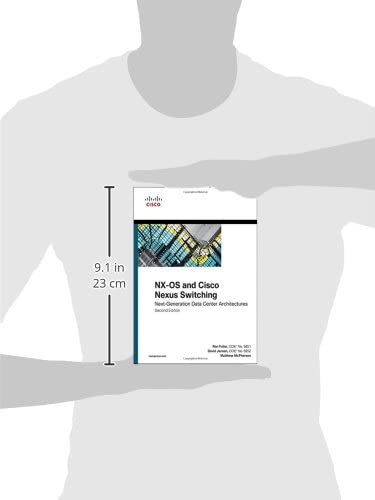
This image illustrates the physical size of the book, showing it held in hands with measurements indicating a height of 9.1 inches (23 cm). This provides a visual reference for the book's physical form factor.
Specifikationer
| Forlægger | Cisco Press |
| Udgivelsesdato | 13. marts 2013 |
| Udgave | 2. Udgave |
| Sprog | engelsk |
| Print Længde | 864 sider |
| ISBN-10 | 1587143046 |
| ISBN-13 | 978-1587143045 |
| Varens vægt | 3 pund |
| Dimensioner | 7.4 x 1.9 x 9.1 tommer |
| Serie | Networking Technology |
Support og yderligere ressourcer
For further information, errata, or support related to the content of this book, please refer to the official Cisco Press website or contact their customer support. The authors, Ron Fuller, David Jansen, and Matthew McPherson, are recognized experts in the field of data center architectures and networking.
- Forlægger Webwebsted: For official resources and updates, visit the Cisco Press webwebsted.
- Forfatterinformation: Details about the authors and their contributions can often be found on the publisher's site or professional networking platforms.
- Fællesskabsfora: Engage with other professionals and experts in Cisco networking forums for discussions and problem-solving.


